Strength testing for injury prevention is one of the more practical tools physiotherapists have available. Rather than relying on a patient’s subjective sense of how they’re tracking, objective strength assessments give clinicians something concrete to work with: numbers, ratios, and comparisons against established benchmarks. That shift from estimation to measurement changes the quality of decisions made throughout rehabilitation and return-to-activity planning.
For both athletes pushing back into sport and everyday individuals managing pain or reduced function, the output of a strength assessment can reveal deficits that are invisible to clinical observation alone.
What Strength Testing Actually Measures
A strength assessment goes beyond checking whether a muscle is ‘weak’ or ‘strong.’ Testing typically covers force production (how much force a muscle can generate), side-to-side differences between limbs, and rate of force development, which is how quickly that force can be produced.
These variables matter for different reasons. Force production gives a baseline measure of muscle capacity. Limb symmetry ratios are particularly useful in rehabilitation, where one side of the body has been affected by injury and may be compensating for the other. Rate of force development captures something raw strength testing misses entirely: how fast the neuromuscular system responds when it needs to act.
Results are compared against age- and weight-matched normative data drawn from research. That comparison is what makes objective testing genuinely useful. Instead of saying ‘your quadriceps feel a bit weak,’ a physio can say ‘your left quadriceps produces 68% of the right side, and both sit below the expected range for your age and bodyweight.’ One statement is a clinical impression. The other is a target.
How the AxIT System Works in Practice
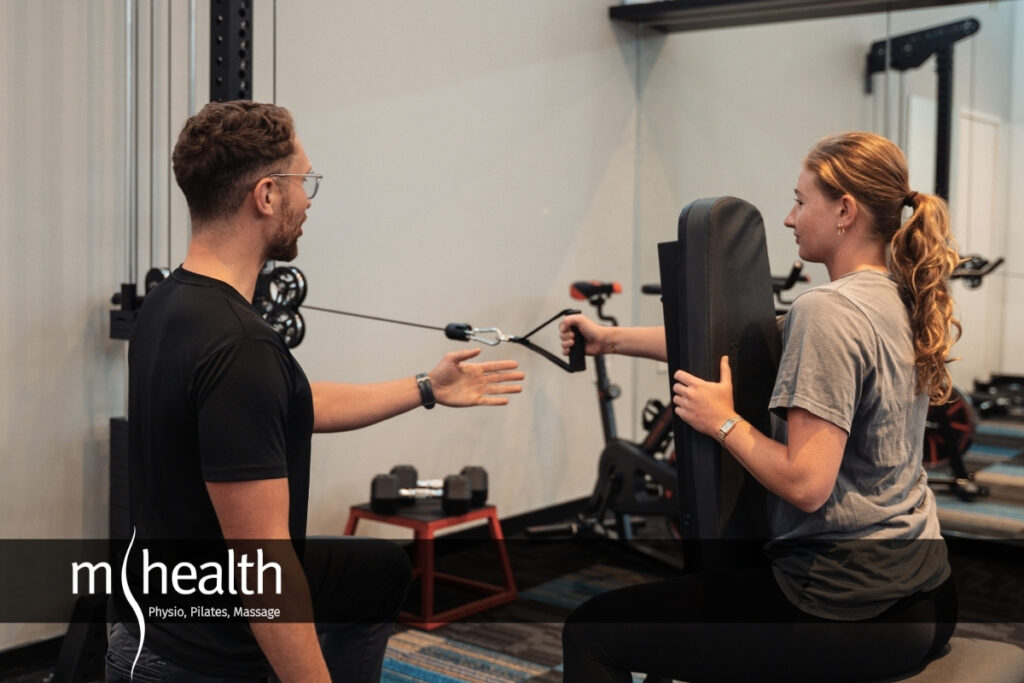
mhealth uses the AxIT system for objective strength testing. The system captures isometric strength output across a range of muscle groups, including the knee, hip, shoulder, and lower limb, without requiring joint movement during the test itself.
That last point matters in clinical practice. Isometric testing generates reliable data without loading an irritated or recovering joint, which makes it practical in early-stage rehabilitation and for patients who are still managing pain. Testing can then progress to more dynamic assessments, including jumping and hopping tests and power-based measures, as the patient’s tolerance improves.
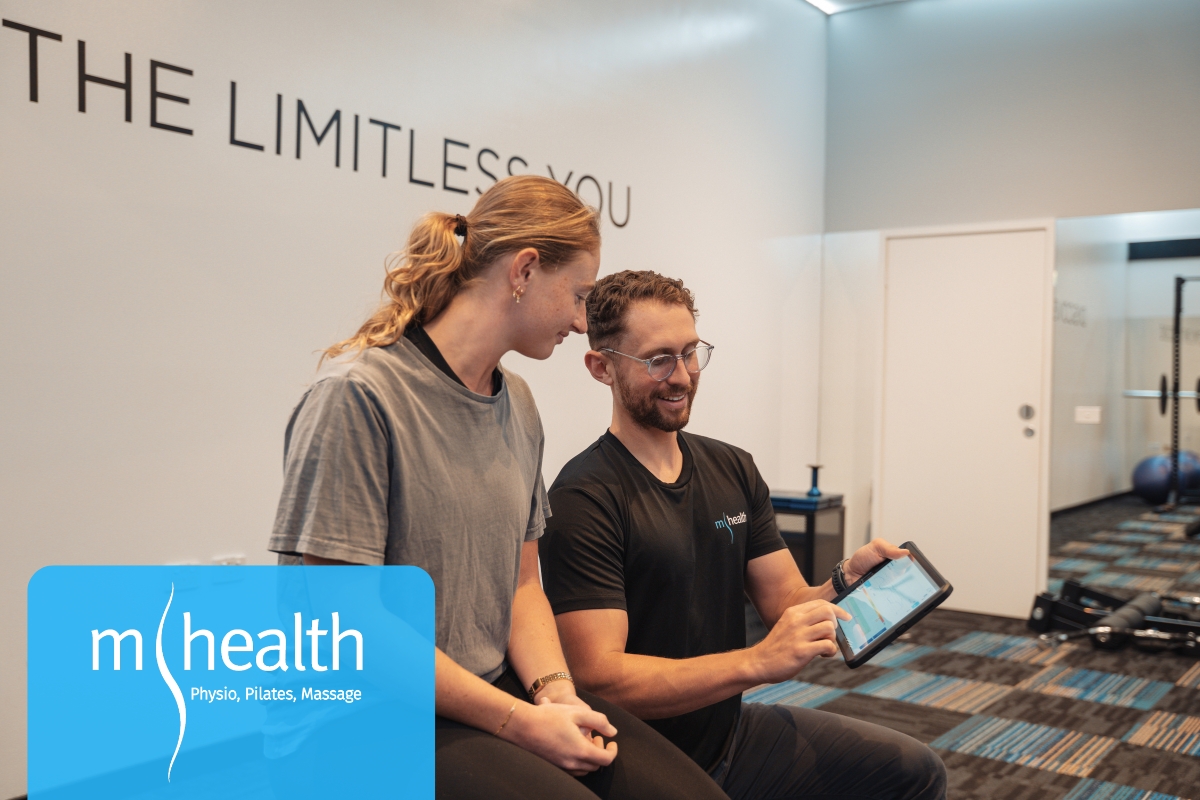
Results can be printed or shared with the patient directly, which helps people understand their progress in concrete terms. Seeing an actual number move in the right direction over successive sessions reinforces adherence to a program in a way that general reassurance often does not.
Rate of Force Development: The Factor Most People Overlook
Rate of force development (RFD) describes how quickly a muscle can ramp up force production in the first milliseconds of contraction. During testing, patients are asked to push or pull as fast and as hard as possible, and the system measures the speed of the force curve rather than just its peak.
For athletes in sports involving sprinting, jumping, or rapid direction changes, RFD is often the limiting factor in injury risk. A player might have adequate maximal strength but still struggle with high-speed performance, or place themselves at risk, if their muscles cannot react fast enough in game-speed situations. Improving RFD through targeted training has a direct effect on both performance and injury resilience.
The same principle applies in a completely different context: older adults and fall prevention. A fall happens in a fraction of a second. The ability to regain balance depends on how quickly leg muscles can fire and produce stabilising force. Adequate strength without adequate rate of force development still leaves a meaningful gap in fall risk, which objective testing is positioned to identify.
Applying Strength Data Across Different Patients
A formal strength assessment at mhealth is structured for both athletes and non-athletes, and the clinical application looks different depending on the patient’s context.
The returning athlete
A recreational football player returning from an ACL reconstruction undergoes lower limb strength testing using the AxIT system. They report feeling ready to return, but testing reveals a significant quadriceps strength deficit on the injured side and reduced rate of force development. Rather than returning to play on a timeline, the program gets adjusted to target those specific deficits. Re-testing over subsequent weeks tracks the improvement, and the return-to-sport decision gets made on actual numbers.
The non-athlete managing chronic pain
A middle-aged patient with persistent knee pain undergoes testing that shows reduced quadriceps and calf strength relative to age-matched norms, alongside poor single-leg control. A targeted program addresses those specific deficits. Repeat testing tracks whether the intervention is working, and visible progress in numbers tends to improve the patient’s confidence in the process.
The older adult focused on staying independent
An older adult presenting with reduced balance and a recent fall undergoes lower limb strength and power testing. Results show reduced force production and slow rate of force development. A program targeting both strength and muscular responsiveness is introduced. Over time, improvements in both areas correspond with better balance scores and reduced fall risk.
What connects these scenarios is the same underlying process: identify specific deficits, design a program around them, and track whether it is working.
What Strength Testing Cannot Tell You
Strength is one part of a broader clinical picture. Pain levels, movement quality, load tolerance, and individual goals all influence how testing results are interpreted and acted on. Limb symmetry ratios, for instance, are a useful guide but not a definitive threshold. Both sides of the body may be below optimal levels, which a simple symmetry comparison would not reveal.
Consistent testing conditions are also important for results to be meaningfully comparable over time. This is why strength testing is most useful when built into an ongoing assessment process, rather than treated as a one-off data point early in treatment.
Strength Testing for Injury Prevention: Your Questions Answered
| Questions | Answers |
|---|---|
| What is strength testing for injury prevention? | Strength testing for injury prevention measures force output, limb symmetry, and rate of force development using specialised equipment such as the AxIT system. Physiotherapists use these results to pinpoint specific muscle deficits and design targeted programs that meaningfully reduce injury risk — rather than relying on generalised exercise or clinical guesswork. |
| Who is a strength assessment suitable for? | Strength assessment is suitable for a wide range of people, including athletes looking to optimise performance, those recovering from injury, people managing chronic pain, and older adults concerned about falls risk. The assessment is adapted to each person’s current capacity and goals, so there’s no baseline level of fitness required to benefit from it. |
| What does the AxIT system measure? | The AxIT system measures isometric strength output across key muscle groups, side-to-side limb differences, and rate of force development. Results are benchmarked against age- and bodyweight-matched normative data, giving your physiotherapist meaningful clinical context — not just raw numbers — to guide your program. |
| Can strength testing support return-to-sport decisions? | Yes, and it does so more reliably than subjective assessment alone. Return-to-sport decisions informed by objective strength and rate-of-force development data take the guesswork out of readiness. Testing confirms whether the recovering limb has the strength and responsiveness needed to meet the actual demands of your sport, reducing the risk of re-injury on return. |
| How is isometric strength testing different from a standard physio assessment? | A standard physio assessment may include manual muscle testing based on the clinician’s judgment. Isometric strength testing goes a step further by using equipment to generate quantifiable force data, including limb symmetry ratios. This makes results reproducible, trackable across sessions, and comparable over time — so progress is measured, not estimated. |
Final Thoughts
Strength testing gives physiotherapists the kind of precision that makes rehabilitation planning more reliable and return-to-activity decisions more defensible. It is not a replacement for clinical judgment, but it gives that judgment something concrete to stand on.
At mhealth, the AxIT system supports this process for patients at every stage, whether they are early in injury rehab, preparing to return to a sport, managing a chronic condition, or simply looking to stay physically capable as they age.
If you want to know where your strength levels sit and what that means for your injury risk, book a strength assessment with the mhealth team.