
“Should I get a scan?” is one of the first questions people ask when back pain hits. It makes sense. You’re in pain, you want answers, and an MRI or X-ray feels like a logical starting point. But for most presentations of lower back pain, imaging is not the first step your treating clinician actually needs, and understanding why can save you money, time, and a fair amount of unnecessary worry.
This post covers how back pain imaging works, when a lower back pain MRI is genuinely warranted, and what tends to produce better outcomes for most people who skip the scan early on.
What a Lower Back Pain MRI Actually Shows
MRI (magnetic resonance imaging) produces detailed images of the soft tissues in your spine, including discs, nerves, ligaments, and surrounding muscles. It’s a genuinely useful tool in specific circumstances. A disc bulge MRI, for example, can confirm nerve compression when leg symptoms suggest a nerve is directly involved.
But here’s the part that catches most people off guard: MRI scans reveal structural changes in the spine whether or not those changes are responsible for your pain. They cannot distinguish between a finding that’s relevant to your symptoms and one that has been sitting there quietly for years without causing any trouble.
This distinction matters far more than most people appreciate, and it’s the foundation of why clinical guidelines are now much more cautious about routine back pain imaging.
What Scan Findings Actually Mean
A landmark systematic review by Brinjikji et al., published in the American Journal of Neuroradiology, examined MRI results from thousands of people with no back pain at all. The results were striking. Disc bulges appeared in 30% of pain-free 20-year-olds and in 84% of pain-free 80-year-olds. Disc degeneration was present in 37% of asymptomatic 20-year-olds and 96% of asymptomatic 80-year-olds.
These are not abnormalities in any meaningful clinical sense. They are a normal part of how spines change over time, much like changes in skin or joint tissue that occur with age. The problem is that once “disc bulge” appears on a radiology report, it becomes very difficult to set aside, even when it is not the actual source of your pain.
This is precisely why both Choosing Wisely Australia and the Royal Australian and New Zealand College of Radiologists (RANZCR) advise against routine imaging for non-specific low back pain. Clinical trials have found no meaningful advantage to scanning early, and some evidence points to worse outcomes, partly because incidental findings generate anxiety that actively complicates recovery.
When to Get a Scan for Back Pain
Routine scanning for typical low back pain isn’t recommended, but there are specific situations where back pain imaging genuinely changes the clinical picture and the decisions that follow from it.
Your physiotherapist or GP will look for what are known as ‘red flags’: presentations that suggest something more serious needs investigation. These include:
- Pain that followed significant trauma such as a fall or car accident
- Unexplained weight loss alongside back pain
- Pain that is severe, constant, and completely unaffected by position or movement
- Bladder or bowel changes occurring alongside back pain
- A personal history of cancer, or consistent night pain that wakes you from sleep
When none of these are present and the presentation fits a mechanical pattern, scans are unlikely to change the initial treatment approach. A physio assessment can typically identify what’s driving your symptoms based on how you move, where it hurts, what aggravates it, and your history.
Imaging does have a clear role if symptoms aren’t responding to appropriate treatment after a reasonable period. Knowing when to get a scan for back pain really comes down to one question: will the result change what we do next? If the answer is no, the scan adds cost without clinical benefit.
It’s also worth noting that even when imaging findings are relevant, they rarely change the fundamental treatment approach. The same rehabilitation that helps a disc bulge also helps joint irritation and muscle-related pain. What matters most is how your back responds to movement and load, which a physio can assess directly.
A Note on X-Rays for Back Pain
People often ask ‘do I need an X-ray for back pain?’ separately from the MRI question. X-rays capture bone structure, not soft tissue, which makes them unsuitable for most mechanical back pain or disc-related symptoms. They are most relevant when fracture is a concern, particularly in older adults with osteoporosis or after a significant fall. For soft tissue issues like disc irritation or nerve involvement, an X-ray simply doesn’t provide the information needed to guide treatment.
What a Physiotherapy Assessment Gives You Instead
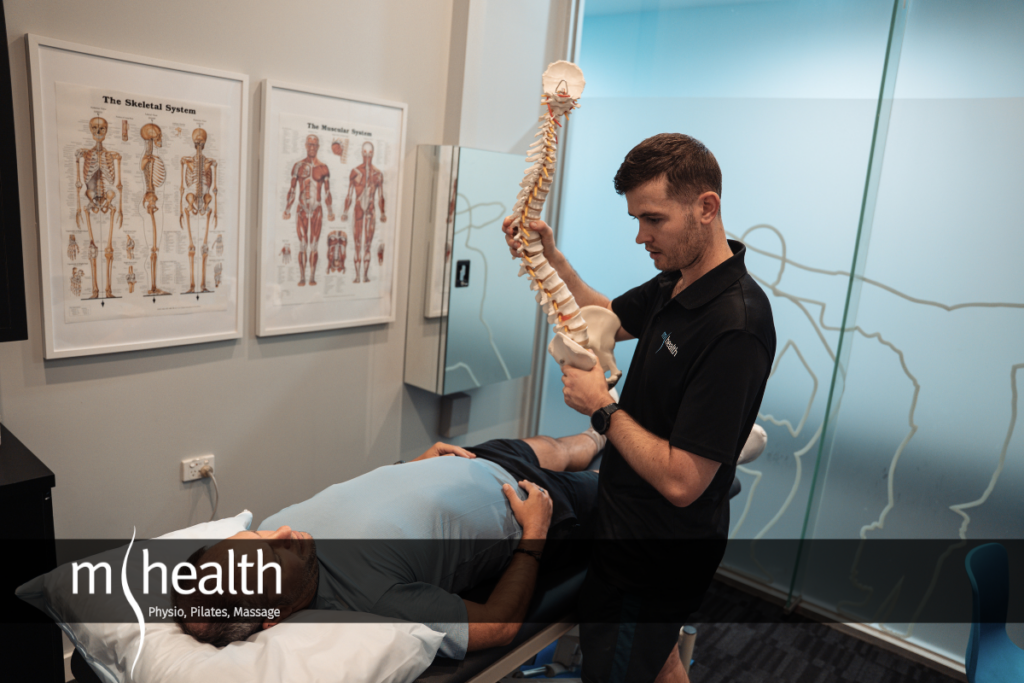
A physiotherapy assessment gives your clinician something that a scan cannot: an understanding of how your back is actually functioning right now. Assessments examine your movement patterns, strength, load capacity, flexibility, and the way your symptoms behave under different conditions and positions.
This information guides a treatment plan that targets the real drivers of your pain, rather than a report finding that may or may not be relevant to what you’re experiencing. For the large majority of people presenting with lower back pain, this approach gets them moving well and out of pain faster than a scan-first pathway.
At mhealth, the initial assessment typically covers functional movement tasks like bending and squatting, specific muscle testing, and a thorough analysis of your pain behaviour and history. If your presentation includes any red flags mentioned above, we will discuss imaging at that point and arrange an appropriate referral.
Our physiotherapy team at mhealth Mentone works through this with you from the first appointment, explaining what we find and what it means for your recovery in plain language.
Lower Back Pain Scans and Imaging: Your Questions Answered
| Question | Answer |
|---|---|
| Do I need a lower back pain MRI before seeing a physio? | No. Most lower back pain does not require imaging before treatment begins. Choosing Wisely Australia and RANZCR advise against routine scans for non-specific back pain. A physio assessment can identify contributing factors and guide treatment without imaging in the majority of cases. |
| Do I need an X-ray for back pain? | X-rays show bone structure, not soft tissue. For most mechanical back pain or disc-related symptoms, X-rays are not informative. They are most relevant when fracture is suspected, particularly in older adults or after significant trauma. |
| What does a disc bulge MRI result actually mean? | A disc bulge on MRI does not automatically explain your pain. Research by Brinjikji et al. found disc bulges in 30% of pain-free 20-year-olds and 84% of pain-free 80-year-olds. These are age-related changes common in people with no symptoms and must be interpreted alongside a clinical assessment. |
| When should I get a scan for back pain? | Imaging is recommended when red flags are present: pain after significant trauma, unexplained weight loss, bladder or bowel changes, or a personal history of cancer. Scans are also appropriate when symptoms are not responding to physiotherapy treatment over a reasonable period. |
| Can a physio assess my back without a scan? | Yes. Physiotherapy assessment evaluates how you move, where your pain is provoked, and what factors are contributing to your symptoms. This clinical information guides treatment more accurately than imaging alone for most lower back pain presentations. |

Final Thoughts
If you’re sitting with lower back pain right now wondering whether you need a lower back pain MRI, the honest answer is: probably not yet. That’s not dismissing your pain. It reflects solid clinical guidelines and research showing that most back pain responds well to physiotherapy, movement, and education, without imaging as a starting point.
Scans remain a valuable part of the toolkit when the clinical picture calls for them. A good physio will recognise when that threshold is reached and refer you for imaging when it will genuinely make a difference to treatment decisions.
Ready to understand what’s driving your back pain? Book an assessment with mhealth Mentone and we’ll help you make sense of your symptoms and build a plan that works.