

Are you a runner looking to improve your performance, prevent injuries, and enhance your overall fitness? If so, you may want to consider incorporating clinical Pilates into your training routine.
Clinical Pilates is a form of exercise that focuses on strengthening the core muscles, improving flexibility, and enhancing coordination.
Clinical Pilates, specifically tailored for runners, takes this exercise method a step further by targeting the specific needs and challenges faced by runners.
Whether you are a seasoned runner or just starting, integrating clinical Pilates into your training regimen can be a game-changer. It can help you optimise your running performance while reducing your risk of injuries.
The most common running injuries
1. Ankle sprains
Tears in the ligaments that support the ankle. They are caused by twisting or rolling the ankle.
2. Runner’s knee (patellofemoral pain syndrome)
A general term for pain around the kneecap, caused by overuse or misalignment of the kneecap.
3. Shin splints
This pain occurs along the front or inside of the shin, caused by overuse or stress on the muscles and bones in the lower leg. It can be caused by sudden increases in training, improper running form, or worn-out shoes.
4. Achilles tendinitis
Inflammation of the Achilles tendon, which connects the calf muscle to the heel bone. It can be caused by overuse, sudden increases in training, or tight calf muscles.
5. Plantar fasciitis
Pain in the heel and arch of the foot, caused by inflammation of the plantar fascia (a band of tissue that supports the arch). It can be caused by overuse, poor arch support, or tight calf muscles.
6. IT band syndrome
Pain on the outside of the knee, caused by friction between the iliotibial band (a thick band of tissue that runs from the hip to the knee) and the femur (thigh bone). It can be caused by weak hip muscles, improper running form, or running on uneven surfaces.
7. Stress fractures
These are small cracks in bones caused by repetitive stress. They are most common in the lower legs and feet. They can be caused by sudden increases in training, improper running form, or inadequate bone density.
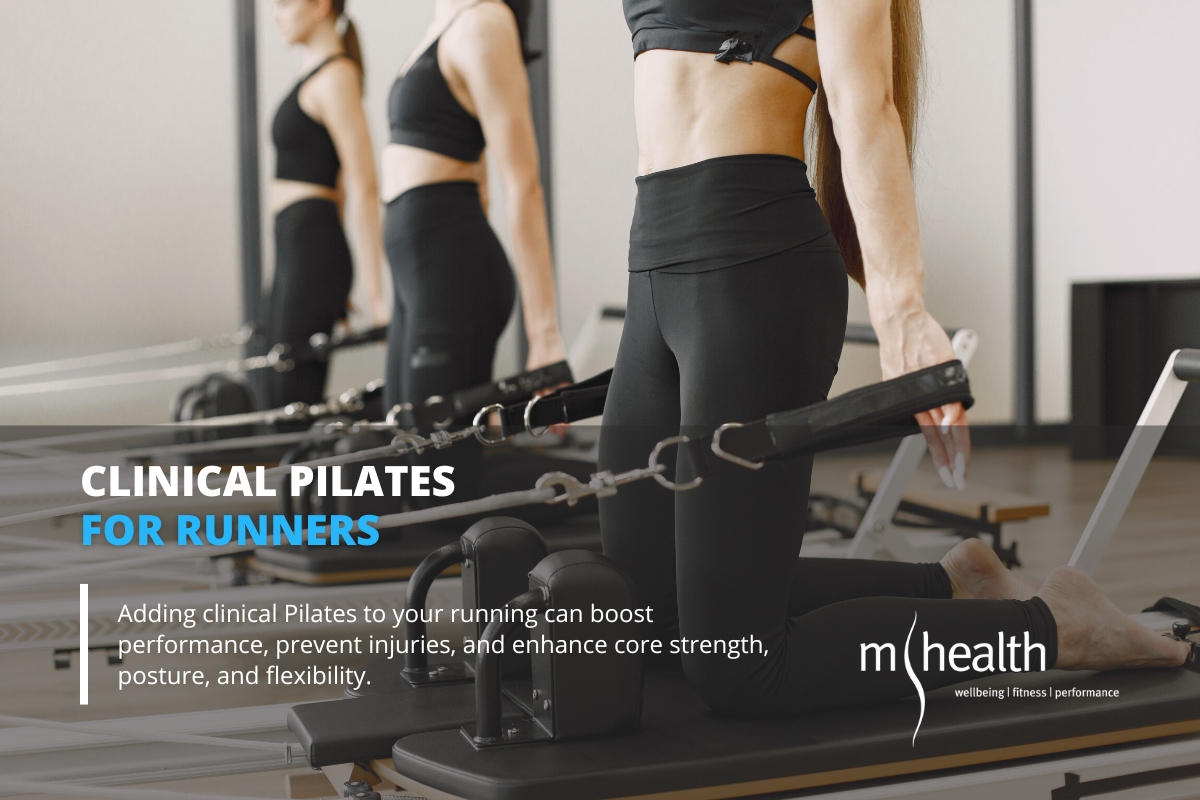
What is the difference between Pilates and clinical Pilates?
While both Pilates and clinical Pilates share the same foundation laid by Joseph Pilates, there are key differences between the two:
- Pilates
Focuses on general fitness and well-being, improving strength, flexibility, balance, core stability, and posture through the six principles of Pilates: concentration, control, centre, breath, flow, and precision.
- Clinical Pilates
Clinical Pilates is run by physiotherapists who have a university degree. Clinical Pilates gives specific attention to each athlete in a class. At mhealth we limit our class sizes to 5 participants so we can focus on every person in the class.
Clinical Pilates run by Physiotherapists involves clinical reasoning and specific selection of what best suits the client to prevent injury and also to improve their performance.
Some classes give everybody the same work to do. Clinical Pilates addresses the individual needs of each athlete.

Benefits of clinical Pilates for runners
1. Improved core strength
A strong core is essential for runners, as it helps to stabilise the spine and pelvis, improve running form, and reduce the risk of back pain.
2. Increased flexibility
Runners often have tight hamstrings, hip flexors, and glutes. Clinical Pilates can help to improve flexibility in these muscles, which can help to improve running stride and reduce the risk of injury.
3. Enhanced coordination
Running is a coordinated movement that requires the use of multiple muscle groups. Clinical Pilates can help to improve coordination between these muscles, which can lead to more efficient and powerful running.
4. Injury prevention
Clinical Pilates can help to identify and address muscle imbalances and weaknesses that can contribute to running injuries. Running-related injuries are often caused by biomechanical imbalances and inefficient functional movements. Clinical Pilates is a series of exercises aimed at retraining normal movement patterns.
5. Improved performance
By improving core strength, flexibility, and coordination, clinical Pilates can help runners run faster and longer with less fatigue.
6. Improved running form
Clinical Pilates exercises can help improve running form by teaching runners to use their core muscles more effectively, to run with a more upright posture, and to strike the ground with their midfoot.
In addition to these benefits, clinical Pilates can also help runners recover from injuries and improve their mental focus.

Final thoughts
Incorporating clinical Pilates into your running routine can be a game-changer. Not only will it help prevent injuries and improve your performance, but it will also strengthen your core, improve your posture, and enhance your overall flexibility.
So why wait? Take your running to the next level with clinical Pilates and feel the difference it can make in your fitness journey. Lace up those running shoes and get ready to run stronger, faster, and pain-free!
Book your clinical Pilates pre-assessment appointment with one of our highly skilled physiotherapists today!