

The scan report has landed, and somewhere in the jargon is the phrase “disc bulge at L4/L5”. Maybe your GP told you it was common and not to worry. Maybe you went home, typed it into Google at 11pm and found yourself watching spinal surgery videos. Either way, your back hurts and now there is a label on it that sounds serious.
Take a breath. A disc bulge is one of the most common things a spine scan picks up, including in people with no pain at all. For most people, disc bulge treatment means physiotherapy, sensible changes to daily load and time to settle. Surgery is the exception. This guide covers what a disc bulge is, the symptoms it can produce, how we approach rehab at mhealth and the signs that mean you should see a doctor quickly.
A disc bulge on your scan is more common than you think
In 2015, Brinjikji and colleagues published a systematic review in the American Journal of Neuroradiology that pooled imaging results from more than 3,000 people who had no back pain. Disc bulges showed up in 30% of pain-free 20-year-olds. By age 50 that figure was around 60%, and by 80 it reached 84%. Disc degeneration followed the same pattern, rising from 37% at age 20 to 96% at age 80.
Put simply, a large share of adults are walking around with disc bulges they will never know about. Finding one on your scan confirms that your spine has aged like most spines do. It does not prove the bulge is the source of your pain, and it says nothing about how well you will recover. We go into this in more depth in our article on lower back pain MRI results and when scans are useful.
None of this means your pain isn’t real. It means the scan is one piece of information, and how your back moves and responds to load usually tells your physio more.
What a disc bulge actually is
Each intervertebral disc sits between two vertebrae and works as a shock absorber. It has a tough, fibrous outer ring (the annulus) and a softer, gel-like centre (the nucleus). A disc bulge describes a disc that extends a little beyond its normal border across a broad section of its edge, a bit like a car tyre that sits slightly wider under load.
A herniation (sometimes called a protrusion or extrusion) is different. Here the inner material pushes through a weaker point in the outer ring and sits further out in a more focal spot. Herniations are more likely to press on or irritate a nearby nerve. The term “slipped disc” is common but misleading, because discs are firmly attached to the vertebrae above and below and cannot slip out of place. Our lower back pain page explains how disc-related pain fits alongside the other common sources of a sore back.
Why bulging disc L4 L5 findings are so common
The L4/L5 and L5/S1 levels sit at the base of the lumbar spine, where load and movement are greatest. They are where the large majority of lumbar disc changes appear, which is why “bulging disc L4 L5” is such a common line on a radiology report. The nerve roots that exit at these levels travel into the buttock and leg, so irritation here can produce symptoms well below the back.
Disc bulge causes
There is rarely one single cause. Age-related change in the disc is the biggest contributor, and research on twins suggests genetics plays a larger role in disc degeneration than most people expect. Repeated bending and lifting, a sudden heavy lift combined with twisting, long periods of sitting with little movement and smoking have all been linked with disc problems. Our guide to lower back pain causes covers the wider list of factors that tend to drive back pain.
Bulging disc symptoms: what you might notice
Disc-related pain can look quite different from one person to the next, and the size of a bulge on a scan does not line up neatly with how much it hurts. Symptoms usually fall into one or more of these patterns.
- Local back pain. An ache or sharp pain across the lower back, often worse with sitting, bending forward or getting up from a chair.
- Referred pain. A deep, hard-to-pinpoint ache spreading into the buttock or back of the thigh. It comes from the disc itself and does not mean a nerve is being compressed.
- Radiculopathy. When a nerve root is irritated or compressed, pain can travel below the knee, sometimes into the foot. It is often sharp, burning or electric, and can come with pins and needles, numbness or weakness in the leg. This is what most people know as sciatica.
Coughing, sneezing or straining can briefly spike disc-related pain, and many people find mornings stiffer. Plenty of people with a disc bulge lower back finding on their scan feel only the first pattern and never develop leg symptoms.
When a disc bulge needs urgent medical attention
Most disc problems can be managed safely with a physio and your GP. A small number of symptoms point to serious nerve compression and need same-day medical assessment. Go to your nearest emergency department if you notice any of the following:
- New difficulty passing urine, or loss of bladder or bowel control
- Numbness around the groin, genitals or inner thighs (saddle numbness)
- Leg weakness that is getting worse, such as a foot that slaps or drags when you walk
- Symptoms spreading into both legs
Severe back pain with fever, unexplained weight loss or a history of cancer should also be checked by a doctor promptly. Without these signs, a disc bulge is very unlikely to need emergency care.
Disc bulge treatment at mhealth: what physio-led rehab looks like
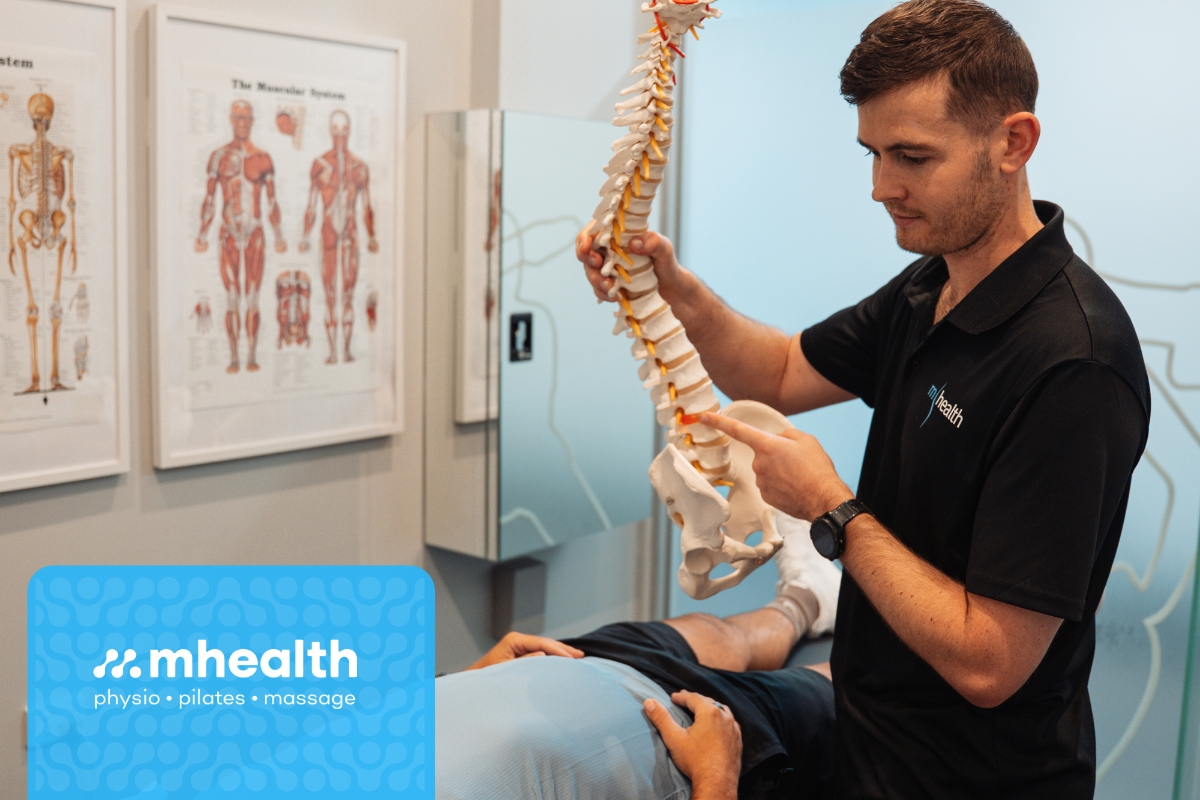
Your first appointment starts with an assessment rather than a treatment plan off the shelf. Our physiotherapy team looks at how you move, which positions ease or aggravate your pain, the strength and endurance of your trunk and hips and whether there are signs of nerve involvement in your legs. We’ll talk through your scan if you have one, and explain in plain language what the findings mean for you.
Load management
Complete bed rest tends to slow recovery, so the aim is to keep you moving at a level your back tolerates. That might mean breaking up long periods of sitting, adjusting how you lift at work or temporarily scaling back running or gym sessions. Some discomfort during activity is often acceptable as long as it settles. Our post on hurt vs harm explains how to tell the difference.
Progressive strengthening
Once pain is more predictable, we build capacity in the muscles that support your spine and hips, then increase the load gradually over weeks. This might start with simple exercises at home and progress into Clinical Pilates or our physio-led mstrong strength classes. Building strength is one of the main ways to reduce the chance of the same problem flaring again. If you need gentle options early on, these low-impact exercises for back pain are a good starting point.
Hands-on therapy
Joint mobilisation, soft tissue work and remedial massage can ease pain and muscle guarding in the short term. We use hands-on treatment to make movement more comfortable, so you can get more out of your exercise program. On its own it is unlikely to produce lasting change, which is why it sits alongside the active parts of your rehab.
Herniated disc treatment without surgery: what the evidence says
Most disc bulges do not require surgery, and conservative care (physiotherapy, activity modification, pain relief guided by your GP and time) produces good outcomes for the majority of people. Disc material that has pushed outwards can also shrink over time. A 2015 meta-analysis by Chiu and colleagues found that many herniated discs show partial or complete regression on follow-up scans, with larger extrusions more likely to reabsorb.
A well-known Dutch trial published in the New England Journal of Medicine (Peul et al., 2007) compared early surgery with prolonged conservative care for people with disc-related sciatica. Surgery relieved leg pain faster, but by 12 months the two groups reported similar results.
Surgery still has an important role. It may be recommended when there is significant or worsening nerve weakness, signs of cauda equina syndrome, or severe leg pain that hasn’t eased after an adequate period of conservative care. If your physio sees any of these, we’ll refer you back to your GP or to a spinal specialist.
Disc bulge recovery time
There is no fixed timeline, and anyone who promises one hasn’t assessed you. Recovery depends on whether a nerve is involved, how long symptoms have been present, your general activity levels and factors such as sleep and stress. Back pain without leg symptoms often improves over a period of weeks. Nerve-related leg pain tends to take longer, sometimes a few months. Progress is rarely a straight line, and a flare-up partway through does not mean you are back at square one. Your physio will track measurable changes, like how long you can sit or how far you can walk, so you can see progress even on harder days.
Disc Bulge Treatment And Recovery: Your Questions Answered
| Question | Answer |
|---|---|
| What is the best disc bulge treatment? | For most people, the most effective disc bulge treatment is conservative care led by a physiotherapist. This usually combines staying active within comfortable limits, progressive strengthening of the trunk and hips and hands-on therapy for short-term relief. Surgery is generally reserved for serious nerve compression or symptoms that don’t settle with appropriate care. |
| What are common bulging disc symptoms? | Bulging disc symptoms vary. Some people feel a local ache in the lower back, often worse with sitting or bending. Others notice a deep ache referred into the buttock or thigh. If a nerve root is irritated, pain can travel below the knee with pins and needles, numbness or leg weakness, often described as sciatica. |
| How long is disc bulge recovery time? | Disc bulge recovery time differs from person to person. Back pain without leg symptoms often improves over several weeks, while nerve-related leg pain can take a few months. Recovery depends on nerve involvement, how long symptoms have been present, activity levels, sleep and stress. A physio can track measurable progress along the way. |
| Can a herniated disc be treated without surgery? | Yes. Herniated disc treatment without surgery works for most people. Research shows many herniated discs partly or fully reabsorb over time. A 2007 trial in the New England Journal of Medicine found surgery relieved leg pain faster, but outcomes at 12 months were similar to prolonged conservative care for people with sciatica. |
| Is a disc bulge at L4 L5 serious? | A bulging disc at L4 L5 is one of the most common scan findings and is often seen in people with no pain. It becomes more significant if it irritates a nerve and causes leg pain, numbness or weakness. Seek urgent care for bladder or bowel changes, saddle numbness or worsening leg weakness. |
Final thoughts
A disc bulge on your scan is a common finding, and on its own it doesn’t decide how your back will feel in six months. The best disc bulge treatment for most people combines an accurate assessment, sensible load management and progressive strengthening, with hands-on therapy to help along the way. Leg symptoms, worsening weakness or changes to bladder or bowel function need medical attention. For everyone else, a clear explanation and a plan you understand will go a long way toward settling the worry as well as the pain.
If you’ve been told you have a disc bulge and aren’t sure what to do next, book an assessment with mhealth Mentone or call (03) 8585 2222. Our physios will explain what’s going on and build a plan around your goals.
References
- Brinjikji W, et al. Systematic literature review of imaging features of spinal degeneration in asymptomatic populations. AJNR Am J Neuroradiol. 2015;36(4):811-816.
- Chiu CC, et al. The probability of spontaneous regression of lumbar herniated disc: a systematic review. Clin Rehabil. 2015;29(2):184-195.
- Peul WC, et al. Surgery versus prolonged conservative treatment for sciatica. N Engl J Med. 2007;356(22):2245-2256.